 Airports & Sceneries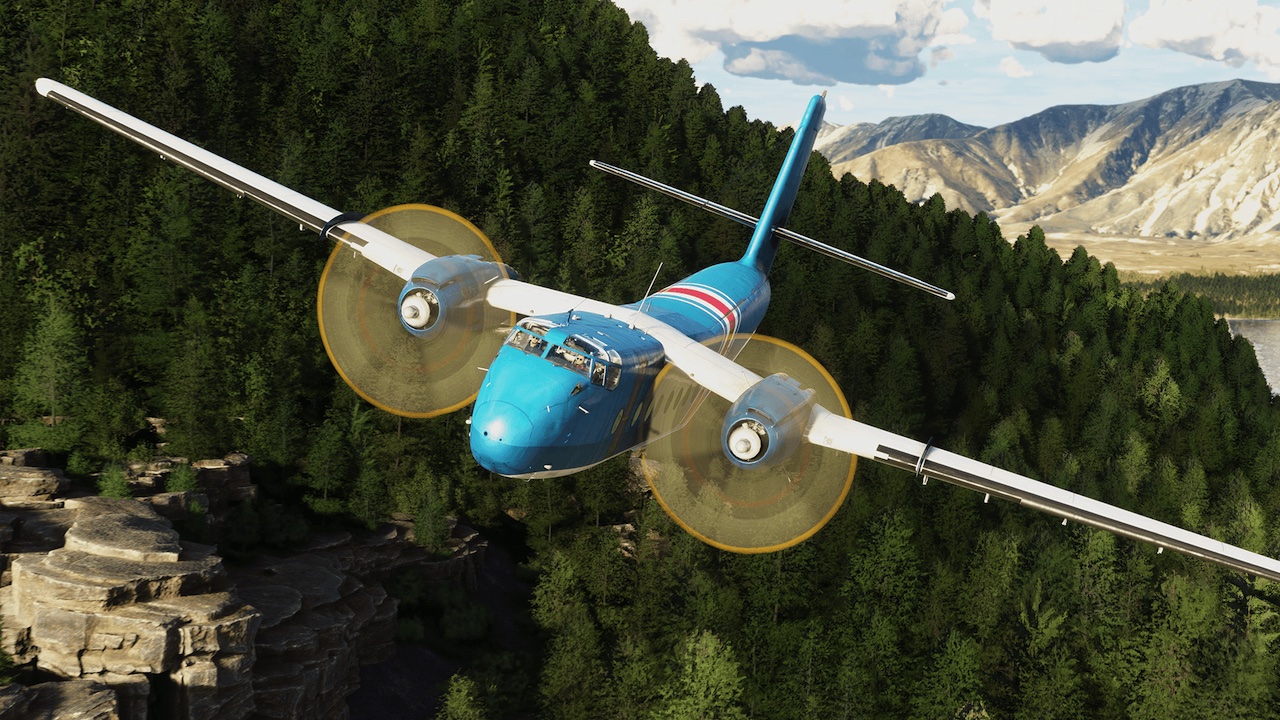
– No official changelog provided
The Caribou first flew on July 30, 1958, and was introduced into mainline service in 1961. De Havilland built a total of 307 Caribou planes, with the majority going into military service, and the rest serving civil missions. 32 countries’ militaries flew the Caribou, including that of the United States. Designated first as the CV-2 and then as the C-7, the United States Army and the United States Air Force operated a total of 159 of the planes. Spain, Kenya, India, and Australia also used the airframe until 2009.
The DHC-4, crewed by two pilots, can carry up to 32 troops and their gear along with 8,000 pounds of cargo or some combination thereof. The Caribou has a distinct, utilitarian look, featuring a long, narrow fuselage with a rear cargo ramp and elevated tail section, allowing for easy and efficient loading and offloading of equipment and personnel. It can also execute in-flight drops of equipment and / or paratroops on demand. The empennage is a cruciform design, with a large vertical stabilizer and rudder for low-speed yaw authority and it has a retractable tricycle undercarriage with long landing gear legs for use in remote, rustic airfields.
The high aspect ratio design of the main wing is mounted on the forward of the fuselage and has full-span, double-slotted flaps. The wing has a polyhedral, inverted gull form and supports its two radial engines in nacelles that also serve as mounts for the main landing gear. Finally, the aircraft is powered by two Pratt & Whitney R-2000 Twin Wasp 14-cylinder radial piston engines that each deliver 1,450 horsepower and turn a 3-blade Hamilton Standard constant-speed, reversible-pitch propeller.
