 Airports & Sceneries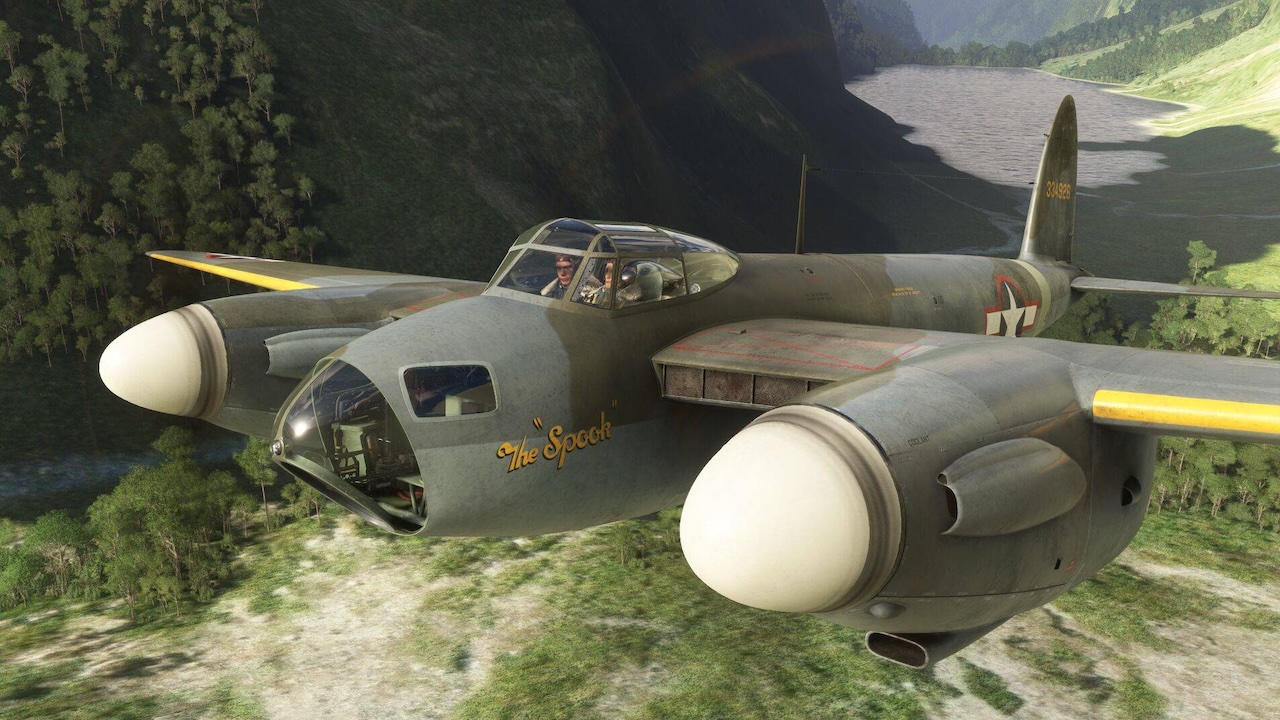
– Better ground handling and handling during take off.
– Translations for all languages.
– Slightly less agressive brakes.
The Mosquito’s fuselage was made from cold-molded plywood formed in concrete molds, allowing wiring and equipment to be installed before final assembly, speeding up construction. Most of the aircraft, including its one-piece wings with a span of 54 ft 2 in and a total wing area of 454 sq ft, used laminated plywood and hardwood, with metal reserved only for critical structural components. Measuring 44 ft 6 in length wise and 17 ft 5 in height wise, this method resulted in a strong but lightweight airframe.
The reduced weight – an empty weight of 14,300 lb and a maximum weight of 18,100 lb, combined with two Rolls-Royce Merlin V-12 liquid-cooled piston engines producing 1,430 hp each, gave the Mosquito exceptional speed and performance. It could reach a maximum speed of 380 mph at 14,000 ft and operate at a service ceiling of 37,000 ft (11,000 m). It was produced in 43 variants, with the Mk VI Fighter Bomber being the most common. Specialised versions served with the Royal Navy and the RAF, including night fighters and pathfinder aircraft that relied on speed and low-level flying to mark targets ahead of bomber formations.
Because of its speed and versatility, the Mosquito was used in many daring and covert missions, including famous raids such as Operation Jericho and attacks on Gestapo headquarters. It served with around 20 air forces and remained in action until the 1950s. Several are under restoration and the aircraft remains admired for its beauty, innovation, and remarkable wartime legacy.
Features:
• Do-it-yourself Mosquito allows you to make your own squadron all from the game!
• Hi Fidelity models with exceptional levels of detail
• Beautifully crafted exterior and interior models have been built using the best drawings and references available
• Highly detailed Rolls-Royce Merlin engines
• Optional modern radios, load-out options and navigator positions
• Accurate flight dynamics and performance envelope
• Authentic sound packs developed by Echo19
• Realistic systems and start routines
10 liveries:
• Dz383/? of No 138 wing,2nd TAF, Lasham, September 1944
• DK333/HS-F “Grim Reaper” No 109 Sqn, No 8 group, Wyton, January 1943
• Dz637/AZ-X No627 Sqn, No5 Group, Woodhall Spa, 3 July 1944
• “BOAC” Unarmed high speed courier)
• DZ353/GB-E No 105 sqn No 2 group, December 1942
• DK296/GB-G No 105 sqn, September 1942
• NS519 653rd bomb squadron, october 1944
• F8 Mosquito 43-34926 “The spook”
• CF-FZG Canadian racer (based on b35)
• Raw factory finish
• DIY mosquito blank livery (check manual)
