 Airports & Sceneries
– New Features:
– Completely new full state saving system with 320 parameters, using JavaScript state saving, rather than state.cfg. See the “Full State Saving” section of this manual for more information on the system, and the “Options Page” section for configuration options.
– New Lycoming continuous fuel injection simulation and starting procedures.
– WARNING: This aircraft now accurately starts with the mixture lever in idle cut-off. Attempting to start with the mixture at full-rich will likely result in a flooded engine.
– Lycoming engines have fundamentally different fuel injection systems than Continental engines. While starting continental engines at full-rich is standard procedure, Lycoming engines should be started with the mixture in idle cut-off to prevent flooding. With the mixture in idle cut-off, crank the engine until combustion is observed. While releasing the starter switch, quickly advance the mixture lever to continue combustion.
– Attempting to start the engine with the mixture lever forward will result in a flooded engine. Flooded engines are cleared by placing the throttle fully forward, and cranking the engine for approximately 15 seconds. The in-game checklists and checklists in the manual have been updated to reflect these new procedures.
– Added sounds to preflight actions from the shared Asobo sound library.
– Added control surface interactions for preflight using custom interaction code that integrates well with the aircraft’s other features, like control locks, and simulates flap push-rod play.
– Added numerous sounds pertaining to engine damage during startup, shutdown, at all power settings, and several piston specific operating conditions, like overly lean or rich mixture.
– Added new volumetric fuel flow calculation, after researching on more recent Black Square aircraft. This eliminates erroneous fuel flow increase when leaning, providing more realistic cruise operation. All cruise performance tables have remained unchanged, although fuel flow may differ at specific mixture lever positions relative to previous versions of this aircraft.
– Overhauled several EDM 760 features, including (LOP) leaning function. The lean of peak function now includes all the steps of the real unit, first finding the leanest cylinder, and only then finding the richest, with the relative temperature being properly reset at each step. The result is more accurate fuel flows that represent maximum power ROP and economy LOP cruising. Also, a small code mistake disabled using the LF button to toggle between relative EGT and absolute EGT after leaning was complete. Also, implemented holding the LF button to momentarily show the captured peak EGT and fuel flow at that peak. Lastly, increased polling rate of peaking-finding mode to more accurately find peak EGT (now 10 times per second). Also increased the size of the “both” buttons clickspot. Finally, improved the startup sequence for more accuracy, and faster startup times.
– Added new cylinder temperature variation table, and made both CHT and EGT cylinder variations unique in every aircraft. EGT will now be more randomly distributed across cylinders, while CHT will still reflect engine installation geometric differences, dynamic airflow changes due to apparent wind direction, and cooling effects.
– Added dynamic magneto drop for detecting subtle fouling during runup. Both magnetos are no longer identical, as well. Normal drop is ~75 RPM, ~150 RPM is acceptable, and >175 RPM indicates significant fouling. The new fouling sounds have been adjusted to follow a gentler curve, giving you room to detect fouling with the magnetos alone, giving greater purpose to the runup.
– Added magneto timing failures, which produce an extra RPM drop during runup, and limit the maximum achievable RPM. These failures have also been added to the new engine sounds, so they are detectable during flight with subtle sound changes.
– Huge improvement to cylinder fouling symptoms, which eliminates jumpy manifold pressure, and introduces effects into fuel flow and propeller RPM. Accompanied by the new abnormal engine sounds, this is now a great effect.
– Created a new 9-segment font for the EDM 760, and replaced the 14-segment font a new 9-segment font for more accurate letters and digits. Also modified instrument background textures to match the new font glyphs.
– Added custom external power system, which bypasses the parking spot limitations of MSFS, and avoids random disconnects. External power can now be enabled anywhere.
– Added new custom cylinder head heating/cooling adjustment that debuted with the Black Square Commander 114, and has since been further improved.
– Added improved oil temperature simulation with engine-driven oil pump failure. Electric preoiler can be used to overcome an engine-drive pump failure in flight.
– Added manifold pressure feedback from turbocharger simulation. This is most easily noticed by a delay at atmospheric pressure while advancing the throttles, with the manifold pressure only increasing as the turbocharger spins up to operating RPM. A drop in manifold pressure may also be noticeable at very lower cruise power settings.
– Added magneto impulse coupling failure, which manifests as a significantly more difficult to start engine. The flyweights will not visibly extend from the magneto on the tablet’s engine visualizer when they have failed.
– Added new turbocharger bearing failure, which limits top-end turbocharger performance, with accompanying sound. Maximum manifold pressure will be limited above atmospheric pressure.
– Added new propeller governor failure, which limits the maximum propeller RPM.
– Added disabled visual state to tablet options switches (greyed out), like engine/pitot covers/chocks to provide feedback when these options are not available.
– Custom sounds for all exterior interactions are now audible during walkarounds, like opening and closing doors.
– Added viscosity influence on custom oil pressure calculation.
– Added temperature dependent CRT warmup effect to weather radar screen.
– Added new engine fire effect by repurposing the backfire effect with new code, and reduced damage caused by an engine fire to give more time for troubleshooting.
– When the remote compass is slewed to an incorrect magnetic heading, the autopilot will now follow the HSI’s heading bug to this new incorrect heading.
– Added Oxygen Duration Table (Hours) to manual, and improved calculation of oxygen consumption in code to be normalized to a 77 cubic foot supply cylinder.
– Setting L:BKSQ_IgnitionPosition_1 (or _2) to a value of 5 will now engage the starter without it spring returning to the magneto both position. Also fixed a particular event used to trigger the starter, which may prevent conflicts with some hardware bindings.
– Added accurate trim tab movement, particularly noticeable on walkarounds.
– Added thickness to cockpit window, apparent when the pilot’s storm window is open.
– Added sound for armrest stops.
– Extended tablet clickspot along the pilot’s side wall towards the nose to better match more recent Black Square aircraft.
– Bug Fixes:
– Finally found the cause of erroneous nose gear touchdown chirping while taxiing and rolling down the runway.
– The new volumetric fuel flow calculations have the side effect of eliminating some “weirdness” to the sign of relative fuel flow after leaning on the EDM 760, which was applied to overcome previous shortcomings in the simulator’s fuel flow code.
– Fixed exterior aileron and elevator stop sounds, which previously played partway through the throw of the surface.
– Fixed engine starting physics system, which previously gave the impression of too many compression wells due to a multiplication by 4 pi, where it should have been 2 pi. Physics constants were tweaked for more realistic starting appearance, as well.
– Fixed an incorrect radian conversion that could cause the propeller to jitter when stopping at some angles.
– Fixed off-by-one error that may have affected pressurization capacity based on pressurization shutoff handle position.
– Previously, the engine monitor DIF page displayed the result of the search for the outlier cylinder EGT, rather than the absolute difference between the hottest and coldest EGT.
– Fixed visual synchronization problem with the tablet failure interface when failures were triggered from HTML events, in preparation for collaboration with online services.
– Expanded environmental occluder mesh to eliminate artifacting during reduced visibility.
– Fixed possibly missing button sounds for the pedestal glideslope autopilot button.
– The “false combustion” sound would only play once, and never again.
– Fixed issue where oil pressure would momentarily rise while exercising propellers.
– Corrected outside air temperature probe to read TAT instead of OAT.
– Removed magneto impulse couplings from right magneto on engine visualizer.
– Fixed a materials parameter for more vibrant rivets, and better color matching with metallic liveries.
– Added missing “PUSH CRSR” integrated lighting on GNS 430.
– Dynamic registrations on the left side of the aircraft may have been only medium weight fonts, instead of bold, with some 3rd party liveries due to a misplaced curly bracket.
– Reordered the failures as they appear on the tablet display so that catastrophic engine failures appear at the top of the list, matching the order in other Black Square aircraft.
– Fixed a row of rivets on the left elevator which previously did not receive paint color.
– Removed “Cloud Strobe Effect” from tablet options list, as the effect will now be permanently enabled. (The effect is not as severe as I had once worried, and I have never received any complaints about it.)
Black Square’s new tablet interface lets you configure all options, manage payload, control failures, and monitor engines, electrical schematics, and environmental control systems, all from within the simulator. The failure system allows for persistent wear, MTBF and scheduled failures for nearly every component in the aircraft. The Piston Duke’s electrical system is highly accurate, featuring a battery temperature monitor, over-voltage protection and AC inverters. The 3D gauges are modelled and coded to meticulously match their real-world counterparts. No piece of equipment appears in a Black Square aircraft without a real-world unit as reference.
Radio navigation systems are available from several eras of the Duke’s history, so users can fly without GPS via a Bendix KNS-81 RNAV system or with the convenience of a Garmin GTN 750 (PMS50 or TDS). Other radio equipment includes KX-155 NAV/COM radios, KLN-90B, GTN 650, KR 87 ADF, KDI 572 DME, GTX 327 Transponder, Century IV Autopilot and a Bendix RDR1150XL Weather Radar.
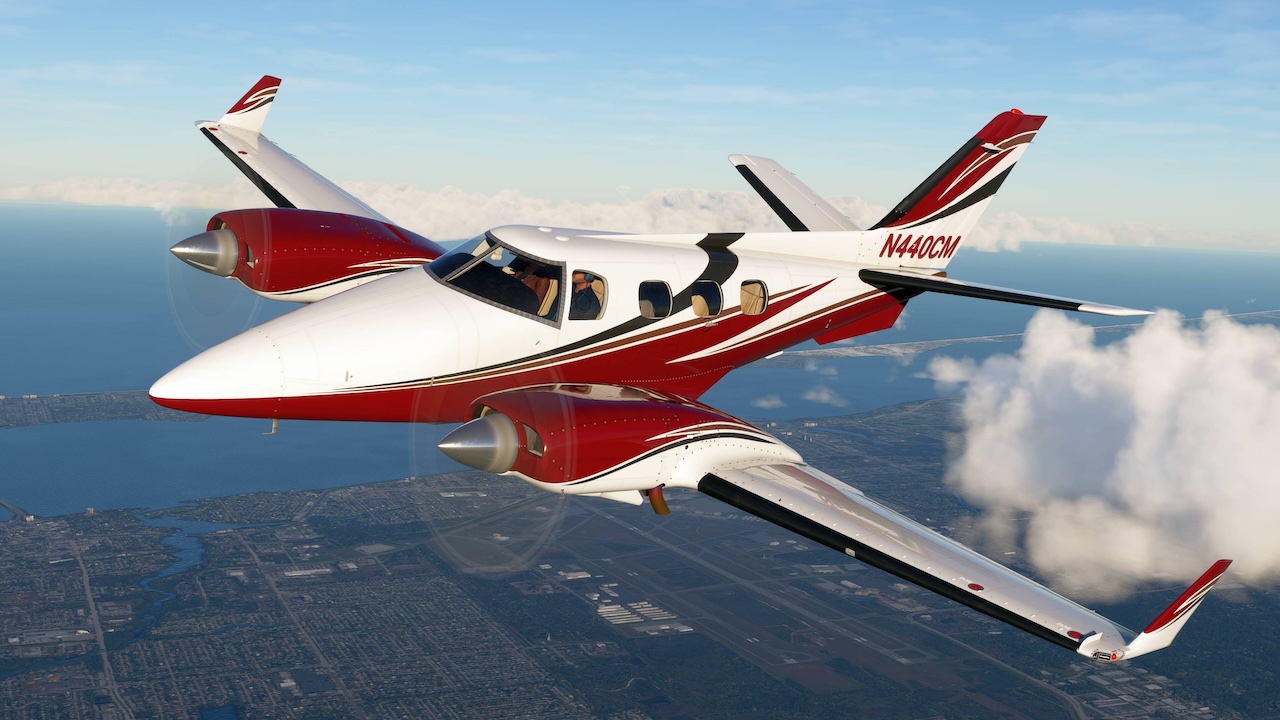
A 160+ page manual provides instruction on all equipment and 50 in-game checklists with control/instrument highlighting are included for normal and emergency procedures. This product includes two versions of the 1974 B60 Duke: with and without the ‘Grand Duke’ performance package (winglets, vortex generators, strakes, extra fuel, increased speeds and increased MGTOW).
Four distinctive interiors and seven paint schemes are included from four decades of flying.
Primarily analogue instrumentation augmented with modern radio navigation equipment is still the most common aircraft panel configuration in the world. Challenge your piloting skills by flying IFR to minimums with a fully analogue panel and no GPS. You’ll be amazed at the level of skill and proficiency you can achieve to conquer such adversity and how it will translate to all your other flying. You may also find the analogue instrumentation much easier to read with the limited number of pixels available on a computer monitor, and even more so in VR.
