 Airports & Sceneries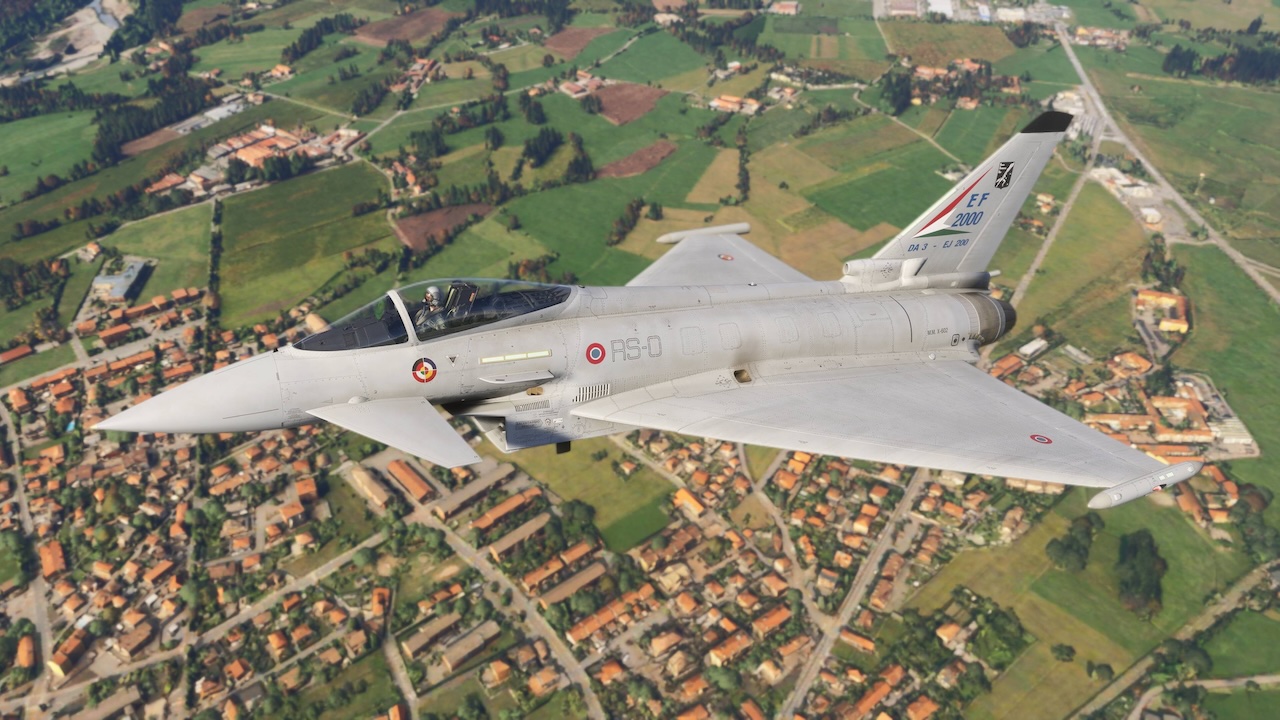
– External Model:
– Fixed minor export glitch in pilot figure geometry
– Systems:
– Fixed bug preventing formation lights to work correctly on version 1.0.9
– Miscellaneous:
– Changes to pilot visibility code
v1.0.9:
– External Model:
– Added Storm Shadow missile
– Cockpit Model:
– General optimization of geometry and textures
– Added multiple LODs
– Flight Model:
– Changed afterburner settings so that power output is almost continuous and linear with throttle position
– Avionics:
– Fixed HUD speedbrake status (reflects the pilot desired position, not the actual speed brake position)
– Added support to Storm Shadow missile (token weight 3216 lbs)
– Completely redesigned flight plan graphics, method and code in PA format
– Added LL calibration option for MSFS 2020 and 2024 in SWP page
– LL calibration value is saved as permanent variable
– Added Bullseye and FAOR data input pages in SWP mode
– Added present position MARK waypoint option in SWP mode
– PA format: Added basic implementation of Late/Early time and DGS (although predictions are currently based on autothrottle setting)
– PA format: Added basic bullseye grid
– PA format: added map brightness filter
– HOTAS: added possibility to switch between local and zulu time in PA format
– HOTAS: addes possibility to switch filter and bullseye grid in PA format
– Liveries:
– Added Luftwaffe 31-07 special color
– Added Spanish Air Force 462-61, 462-62, 11-57, 14-59 and 14-73 liveries
The Typhoon is a dual-engine, loosely coupled delta canard tailless design, featuring a 53-degree leading edge sweepback, relaxed stability and a digital fly-by-wire control system. It is a highly agile aircraft at all speeds, both subsonic and supersonic, achieved by having intentionally relaxed stability, combined canard and flaperon control surfaces, and a very low wing loading. The quadruplex digital fly-by-wire control system manages the inherent instability, allowing better manoeuvrability than direct pilot control. It is described as ‘carefree’ and prevents the permitted manoeuvre envelope being exceeded.
Roll control is primarily achieved by differential use of the flaperons. Pitch control is by coupled operation of the canards and flaperons. The wing leading edges are fitted with automatic movable slats. A single large rudder provides yaw control. Engines are fed by a chin double intake ramp situated below a splitter plate.
A hydraulically operated air-brake is integrated behind the cockpit, moving into a near-vertical position to maximise drag when required.
The Typhoon uses lightweight construction (82% composites consisting of 70% carbon fibre composite materials and 12% glass fibre reinforced composites) as well as aluminium lithium and titanium components on leading edge surfaces. The airframe has an estimated lifespan of 6,000 flying hours.
Features:
• High detail visual models
• Liveries for every squadron that operates the EF-2000
• Detailed and realistic avionic and systems simulation
• Finely tuned flight model
• Accurate sound package
