 Airports & Sceneries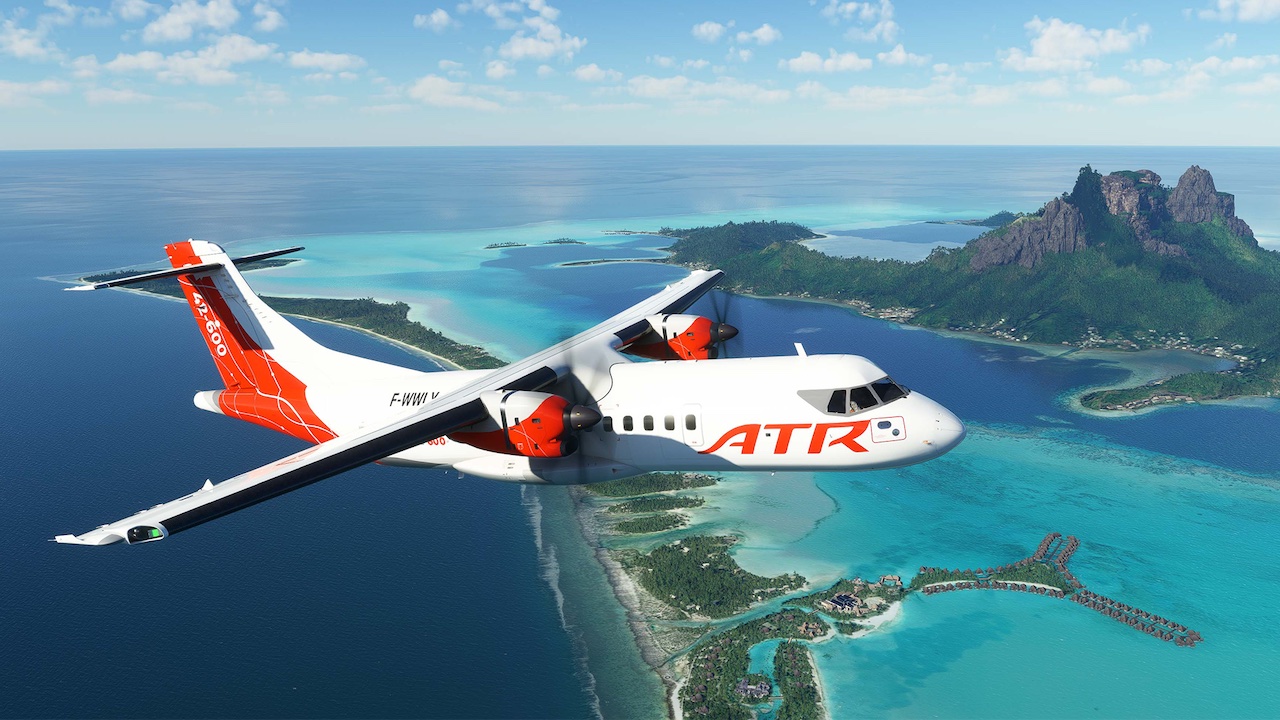
Install by extracting into your MSFS 2020 Community folder and then follow the “microsoft-aircraft-atr\README.txt”! Please follow the installation procedure again even if you used previous versions of this aircraft.
This version has several issues that have been reported to the developer but have not yet been fixed. You can download the previous version here which should work without any problems.
– Fixed standby compass light not turning off when hidden (#687236)
– Added TO Config test sound when checklist is auto-completed
– Fixed brakes checklist autocomplete (#668498)
– Fixed disappearing route leg on MFD
– Fixed lead-in and lead-out calculations for route curve drawing
– Fixed EFB payload figures not updating after Simbrief or sim-EFB import
– Fixed FMA indication for LOC/GS modes
– Unlinked IESI baro from EFB baro sync setting
– COM1 and NAV1 active frequencies now tunable if tuning mode selected on in menu
– Baro, COM1, NAV1 and CRS now directly settable in IESI after selection
– Fixed a bug that caused the flightplan to load without waypoints
– Improved systems reset during turnaround
– Several VNAV fixes
– Fixed missing ToD marker when MANUAL legs or discontinuities followed
– Fixed ToC marker still showing when cruise altitude has been reached
– Fixed a unit conversion issue in loading window when switching between ZFW and PAX/Cargo
– Fixed a rare case when an additional fix would to inserted before a MANUAL leg
– Fixed battery switch OVRD position jumping to OFF
– Improved flight plan drawing on MFD
– Fixed INTC Leg GCLP/03L ODEGI 2A
– Fixed issue with long airport names
v1.0.50:
– Fixed propeller animation (#6797802)
The ATR 42-600
The 42-600 is a twin-engine commuter airliner with a high-wing turboprop, that can seat up to 50 passengers. It took its first flight in March of 2010 and was introduced into service in late 2012. Distinctive in appearance with elegant lines and curves, it boasts thoroughbred performance in the air and can operate out of a wide variety of airfields.
The 42-600 is an advanced iteration of the ATR 42, a family of regional airliners first conceived in the early 1980s. Named “42” due to the number of seats of the original version, the aircraft was designed to be a highly efficient airframe optimized for commuter lines.
The 42-600, operated by a flight crew of two, features an advanced glass cockpit, spacious cabin, and improved efficiency and performance over its predecessors. The aircraft measures 74 feet, 5 inches in length and stands 24 feet, 11 inches tall. It features a high-aspect ratio main wing with a span of 80 feet, 7 inches and a T-tail empennage. It is powered by two Pratt & Whitney Canada PW127XT-M engines, each delivering 2,400 horsepower to a 6-blade propeller.
The 42-600, while not designated a STOL (short take-off and landing) aircraft, has excellent short field and high-density altitude performance, with a take-off run of 3,631 feet at sea level, fully loaded. It has a range of 835 miles and a cruising speed of 345 miles per hour.
The ATR 42-600 comes with three liveries:
• ATR House Livery F-WWLY
• Air Saint Pierre F-ORLB
• Silver Airways N405SV
The ATR 72-600
The 72-600 is a refined, and the most notable, version of the ATR 72, which is a stretched variant of the company’s ATR 42 family of aircraft. The airframe boasts improved cabin design and an advanced multi-panel glass cockpit to optimize pilot efficiency. The ATR 72-600 allows aviators to sharpen their skills and push their abilities to new heights as they cruise the airways around the globe.
The ATR 72-600 is a high-wing, twin-turboprop, regional airliner that took its maiden flight on July 24, 2009, and was introduced into service in 2010. The ATR 72-600 is crewed by two and can carry up to 78 passengers, although its standard configuration is only 70 seats. While primarily serving as a passenger carrier, the 72-600 has also been used by various countries’ militaries for maritime patrol and logistical support.
While designed for and used as a short-haul carrier, the ATR 72-600’s form projects a tone of sportiness and performance. It features a long, sleek fuselage, a T-tail empennage, and has a high-aspect ratio main wing with a slight leading edge sweep. The wingspan measures 88 feet, 9 inches.
The 72-600 is powered by two Pratt & Whitney Canada PW127XT-M turboprop engines that each deliver 2,750 horsepower to 6-blade Hamilton Standard propellers. The ATR 72-600 has a range of 850 miles, a service ceiling of 25,000 feet above sea level, and a cruise speed of 320 miles per hour.
The ATR 72-600 comes with five liveries:
• ATR House Livery F-WWEY
• Silver Airways N703SV
• Air Tahiti “RA’IREVA” F-ORVV
• Air Tahiti “TAPUATA” F-ORVR
• Air Tahiti “TE ANUANUA” F-ORVT
