 Airports & Sceneries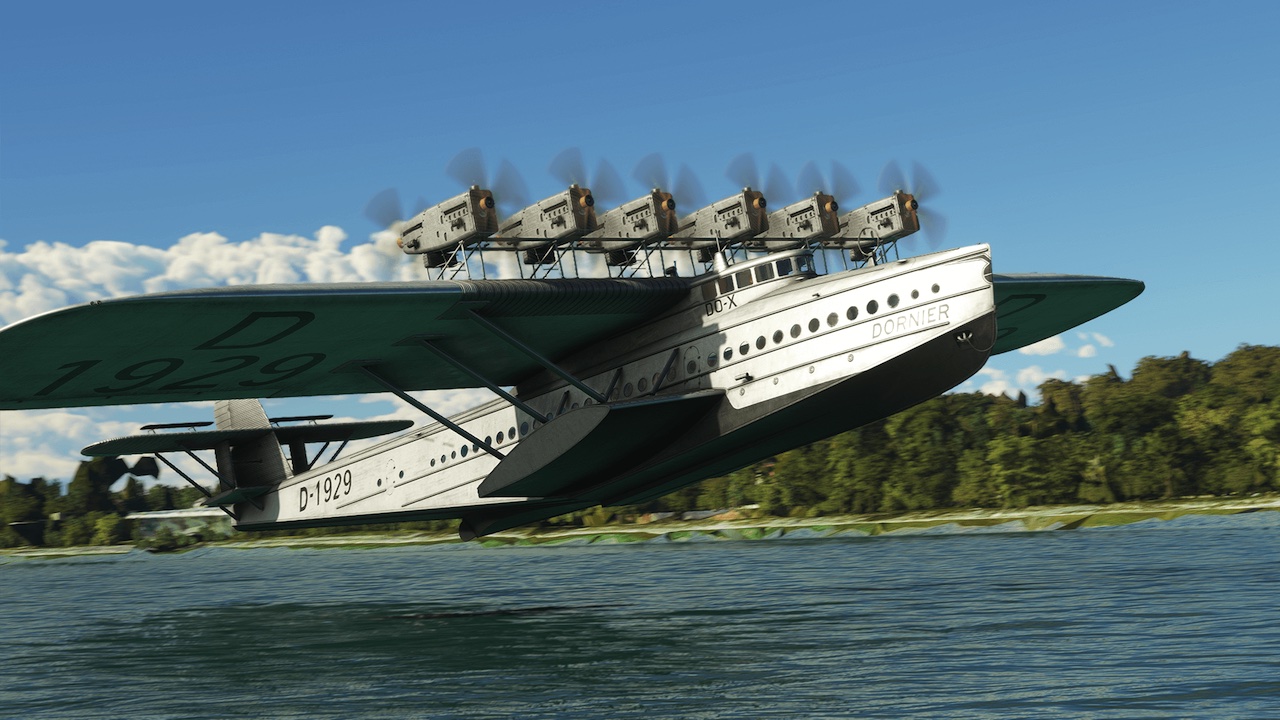
– (2024) Fixed missing thumbnail image when aircraft is selected.
– Increased exterior lighting brightness.
– Fixed cabin light switches A and B to be functional if master battery is off and engine generators are on.
– With no aux engine to supply power to the aux generators, the aux generators have been modified to behave as engine generators 3 and 4, so with any of the 4 generator switches on (Eng 1, Eng 2, Aux 1, Aux 2) power will be supplied to the main bus while the engines are running.
Called a flugschiff (flying ship), Claudius Dornier first conceived of the Do X in 1924, a period in the history of flight when aviation technology was accelerating at a blistering pace and designers strove to create ever larger, faster, and higher-endurance craft. Engineering began on the Do X in September of 1924 with the first set of aircraft drawings. Just under five years later the world’s largest aircraft debuted, a pinnacle of German innovation and engineering. Dornier manufactured three of these during a production run from 1927 to 1932. The airframe operated from 1929 to 1937 in Germany and Italy.
The design consists of a hull with three internal decks and an overall length of 131 feet, 5 inches (40.05 meters), a high main wing with a span of 156 feet, 10 inches (47.8 meters), and sponsons mounted on the lower hull that stabilize the Do X in water and act as complementary wings once aloft.
The lower deck of the aircraft’s hull stored thousands of gallons of fuel. The middle deck had seating for up to 100 people (although when operational, it typically accommodated up to 70). The middle deck also had a lounge with a bar, a dining room, bathrooms, and storage. The upper deck held the crew of up to 14 and all control systems for operating the aircraft, including the cockpit, engine control room, and radio facilities. During one particular flight, a Do X carried 169 people, including passengers and crew, a world record that stood for more than two decades. During its operational tenure, the Dornier Do X drew crowds wherever it went, most notably during a journey from Europe to the United States via Africa and South America.
