 Airports & Sceneries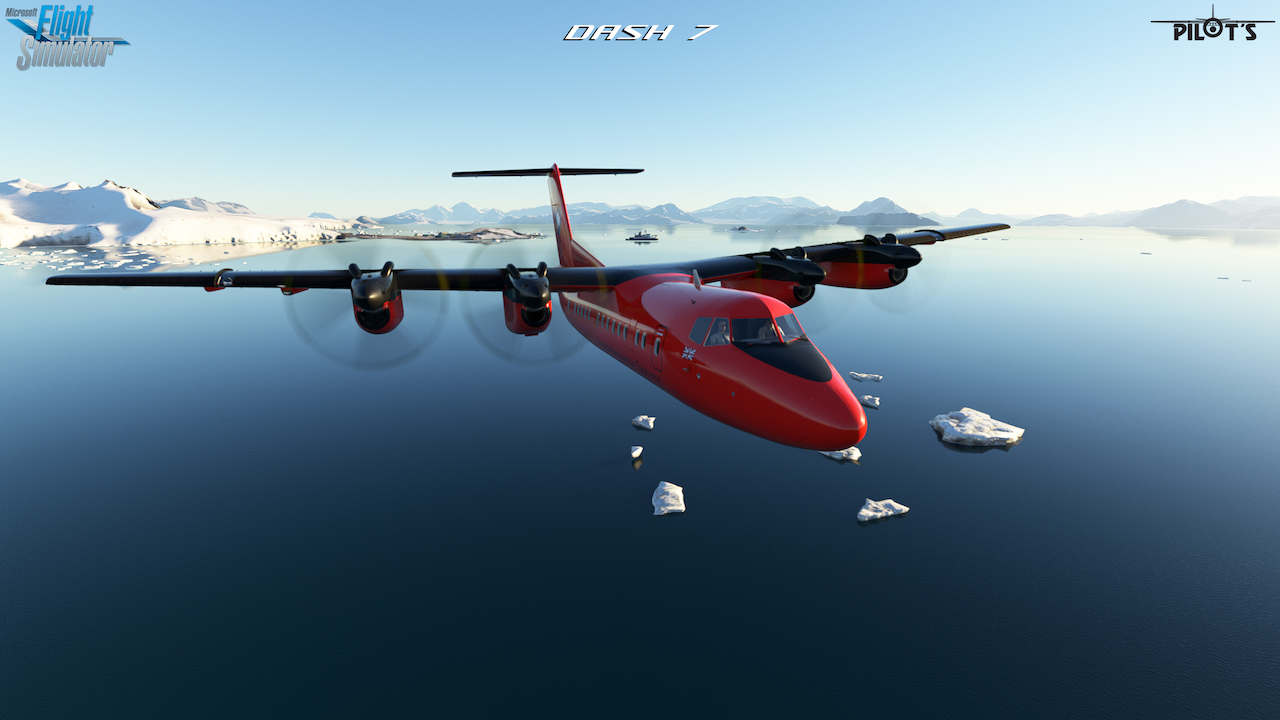
– Major flight model revision using Dash 7 AOM and published aircraft data for substantially improved aerodynamic and operational authenticity.
– Revised wing aerodynamic geometry, including corrected wing camber and thickness characteristics for a more representative Dash 7 STOL wing.
– Revised horizontal stabilizer geometry to more closely match published aircraft dimensions.
– Corrected fuselage dimensions using published Dash 7 dimensional data.
– Corrected elevator travel limits to published aircraft specifications.
– Revised positive and negative structural G limits, including flap-extended limits, to match documented Dash 7 operating limitations.
– Completely revised aircraft empty-weight center of gravity using AOM-derived weight and balance data.
– Repositioned pilot, copilot, passenger and baggage loading stations using documented Dash 7 loading arms for more authentic weight-and-balance behavior.
– Revised fuel tank longitudinal positions to more accurately reproduce the documented aircraft fuel moment and center-of-gravity characteristics.
– Completely redesigned fuel transfer system for authentic tank-to-tank fuel transfer operation.
– Implemented all 12 valid fuel transfer routes between the four individual Dash 7 fuel tanks.
– Corrected physical fuel tank mapping and dedicated engine-to-tank fuel feed assignments.
– Fuel transfer controls now provide clearly identified FROM TANK and TO TANK selections corresponding to the aircraft’s physical tank arrangement.
– Revised fuel transfer control logic for deterministic routing and protection against invalid transfer configurations.
– Fuel transfer operation is now fully independent of the four engine fuel feed selectors, preventing transfer commands from interfering with normal engine fuel supply.
– Revised fuel transfer pump logic and electrical circuit assignments for more reliable and consistent system operation.
– Revised auxiliary fuel pump electrical circuit assignments to better reflect left- and right-side electrical distribution.
– Implemented functional FUEL XFR annunciator logic to provide positive cockpit indication whenever fuel transfer is selected.
– Revised fuel pump annunciator logic to provide appropriate indication during fuel transfer operation.
– Improved fuel transfer switch tooltips with clear physical tank identification for LEFT TIP, LEFT MAIN, RIGHT MAIN and RIGHT TIP tanks.
– Numerous underlying fuel system, electrical and ModelBehavior logic refinements for improved reliability, consistency and operational realism.
With their excellent STOL performance, their designs could fly into smaller airports located in city centres and smaller, outlying, more austere airports having runways that the other aircraft could not easily use (unpaved, unimproved).
A total of 113 aircraft were built until 1988. Product lines were closed at this year since Boieng took over the company.
Features:
• Developed from the ground-up for MSFS
• Full support to integrate the TDS GTNXi and GNS 530 GPS units into the cockpit
• Original steam gauge variant also included
• Authentic and realistic gauges
• Custom Sound Package
• Authentic colour matching and simulated original materials
• 4k Textures
• Livery Air Greenland included
• Livery Air Tindi included
• Livery Berjaya Air included
• Livery Brymon Airways included
• Livery Continental included
• Livery Tyrolean Airways included
• Livery Pan Am included
• Livery Trans World Express included
• Livery Maersk included
• Quick Start Manuals (POH in the works)
